YOUR PROCESSES ARE STILL RUNNING BY HAND
Here's what it costs you
in time, accuracy, and capacity.
Orders re-entered. Reports compiled by hand. Data pulled from one system and pasted into another. Your teams are competent. But they spend a significant share of their time on tasks a machine should handle for them.
Automation and artificial intelligence are not tomorrow's projects. They are concrete operational levers, deployable now, on your existing systems. This article explains why so many processes remain manual, what it actually costs, and how to start.
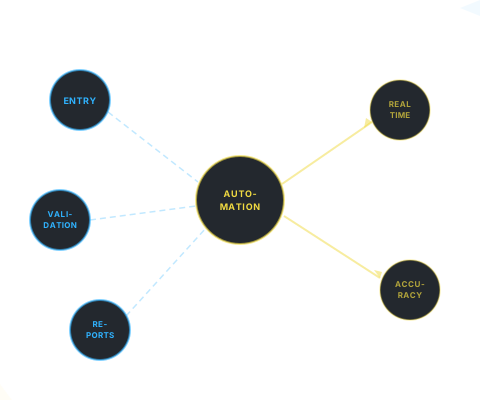
THE SYMPTOMS
Six signs your processes are holding back your growth

Systematic
re-entry
An order comes in through e-commerce. Someone retypes it in the ERP. Someone else adds it to the shipping system. Three entries. Three chances for error.

Monday morning
reports
Every week, someone spends hours extracting data from four systems, pasting it into Excel, and formatting a table. The report is outdated before anyone reads it.

Unstructured
documents
Supplier PDFs, scanned purchase orders, emails with critical data. Everything is read and transcribed manually. The information is trapped in its format.

Avoidable human
validations
An employee checks that the invoice price matches the contract. Another confirms the website inventory reflects the warehouse. These are validations that logic can handle on its own.

Invisible
processes
Nobody documented them. Nobody knows exactly how long they take. But if the person who handles them goes on vacation, everyone notices.

Decisions without
reliable data
The numbers exist, but they are scattered across five systems. Gathering them takes too long, so decisions are made on intuition. Or not made at all.

WHY THIS KEEPS HAPPENING
It's not a lack of will.
It's a lack of visibility.
Manual processes didn't take hold through negligence. They took hold because they worked, at first. Every shortcut, every shared Excel file, every visual check started as a pragmatic solution.
The problem is that these temporary solutions become permanent. And nobody measures their cumulative cost: the time your teams spend on them every week, the silent errors that slip through, the decisions delayed because the information isn't ready. Meanwhile, artificial intelligence has reached a maturity threshold that changes the equation. It can read documents, extract data, validate discrepancies, generate reports. Not as a research project. As an operational tool, today, on your systems.
THE METHOD
We automate what slows you down. We deploy AI where it has measurable impact.
The goal isn't to automate for the sake of automating. It's to give your teams back the time they lose on tasks with no added value, and to give your systems the ability to handle what a human doesn't need to do.
We start by mapping your flows. We identify repetitive tasks, re-entry points, manual validations, bottlenecks. Then we prioritize by impact: the automations that free up the most time first. Some run through APIs and standard synchronizations. Others leverage artificial intelligence to process unstructured content: reading a supplier PDF, extracting relevant data, injecting it into your workflow without human intervention. No overhaul. No migration. Layers of automation that plug into what's already in place.
WHAT CHANGES
When processes run themselves,
everything accelerates.
Automating your processes and integrating AI into your operations doesn't require rethinking everything. It requires targeting the right leverage points.
5x
FASTER
Document
processing
AI reads, extracts, and structures data from your supplier documents in seconds. What used to take an hour of manual entry happens automatically.
80%
LESS RE-ENTRY
Data flows.
Errors don't.
Automations eliminate duplicate entry between your systems. Information is entered once and propagates wherever it's needed.
Real
TIME
Dashboards that
build themselves
Your KPIs update automatically. Reports no longer depend on someone compiling manually. Decisions are made on fresh data.
0
MANUAL INTERVENTION
Critical flows
run themselves
Inventory sync, order validation, price updates: high-frequency processes run without a human stepping in.
25 YEARS OF AUTOMATION
The automations that last are the ones that respect operational reality.
Every organization has its processes, constraints, and reasons. We don't impose a template. We build from what exists, with the teams who know the ground.
We've seen enough automation projects to know what works and what doesn't. What works: identify a specific process, automate it, measure the gain, expand from there. What doesn't: promising AI will transform everything at once. Artificial intelligence is a tool. Powerful, but a tool. It works when deployed with method, on clear use cases, with measurable results. Our longest partnerships all started with one concrete problem. A form to process automatically. A data flow to synchronize. A report to generate without intervention. The rest followed naturally, because results were there.

Yannick Vial
Chief Digital Development and Unified Commerce Officer

Imarcom demonstrates technological creativity and exceptional expertise in a web and omnichannel environment.
Our partnership is built with passion, determination, commitment, and professionalism.

Book online↗ and let's talk about your business goals.
Let's talk!
From seamless integrations to applied AI, we deliver solutions that drive your ambitions forward.
Thank you for your interest
We have received your request and will contact you shortly!
Have a great day