YOUR DATA IS THERE. THE SOFTWARE TO USE IT ISN'T.
Here's what it costs you
in delayed decisions and inaccessible knowledge.
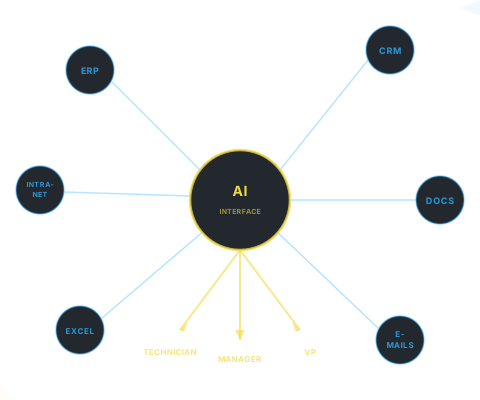
Artificial intelligence and software development now make it possible to build that access layer. APIs that connect your sources, AI that understands questions, interfaces that respond based on the user's role. Not a research project. Operational software, deployable on your existing systems.
WHAT IT COSTS YOU
The information exists. Your teams just can't access it.

Searching instead
of working
Your employees spend hours looking for a procedure, a price, a history. The information is somewhere in the system. Nobody knows exactly where.

Knowledge depends
on people
The answer to most operational questions is “ask Marie” or “call Jean-François.” When these people are away, the information disappears with them.

Six systems, zero
overview
ERP, CRM, shared drives, email, intranet, spreadsheets. Data is everywhere, but no interface brings it together. Every answer requires manual cross-referencing.

Decisions slowed
by missing data
The director asks for a number. It takes three days and four people to produce it. The information existed. It wasn't accessible in a usable format.

APIs that don't
exist yet
Your systems don't expose their data. No gateway, no integration layer. Every cross-system access need is solved with a CSV export or a phone call.

Everyone sees everything,
or nobody sees anything
There's no role-based access logic. A floor technician and a VP search the same place, with the same tools. Or worse, one of them simply doesn't have access.

WHY THIS KEEPS HAPPENING
It's not a data problem.
It's a software problem.
Organizations don't have an information deficit. They have an application architecture deficit. The data is there, fragmented across systems that were never designed to talk to each other. Nobody built the software layer that makes it accessible.
This didn't happen through negligence. It happened because each system was deployed independently, to meet a specific need. The CRM doesn't talk to the ERP. The intranet doesn't know about the shared drive. Critical documents live in email inboxes. Meanwhile, artificial intelligence has reached a threshold where it can read, understand, and retrieve the information contained in all these systems. What's missing is the software that orchestrates all of it: the APIs, the access layer, the interface. That's development. And that's exactly what we do.
THE METHOD
We build the access layer that's missing between your data and your teams.
The goal isn't to centralize your data into a new system. It's to build the software that makes it accessible where it lives, intelligently, securely, and adapted to each role.
We start by mapping your data sources and real use cases: who needs what information, how often, in what context. Then we build. APIs that connect your existing systems. RAG-based artificial intelligence that indexes your documents, databases, and histories. Conversational interfaces where an employee asks a question in natural language and gets the answer filtered by their role and permissions. A technician sees specifications. A manager sees KPIs. A VP sees the big picture. Same question, different answers. This is software development. Not consulting. Code, APIs, AI deployed in production.
25 YEARS OF DATA ARCHITECTURE
The interfaces that last are the ones that respect the complexity of the systems in place.
Every organization has its own data topology, security constraints, and historical reasons. We don't impose a generic product. We build custom, from what exists, with the teams who know the ground.
We've built enough integration layers to know what works and what doesn't. What works: connect one system at a time, validate that information flows correctly, expand from there. What doesn't: promising a unified portal that will solve everything at once. Artificial intelligence is a powerful lever for making data accessible. But it works when deployed with method, on clean sources, with clear permissions. Our longest partnerships all started with one concrete problem. A catalogue to unify. A supplier data flow to automate. A knowledge base to make searchable. The rest followed naturally, because results were there.
WHAT CHANGES
When information becomes accessible,
everything accelerates.
Building the access layer to your data doesn't require replacing everything. It requires building the missing interface.
< 30s
RESPONSE TIME
Answers instead
of searches
An employee asks a question. AI searches across all connected systems and returns the answer in seconds. No more digging through five applications.
100%
SOURCES CONNECTED
One interface,
all the data
ERP, CRM, documents, emails, databases: all your sources accessible from a single entry point, adapted by role.
24/7
AVAILABILITY
Knowledge no longer
depends on anyone
Answers are available around the clock. An employee on vacation no longer blocks a team. Organizational knowledge is captured and accessible through software.
0
UNAUTHORIZED ACCESS
Each role sees
what it should see
Answers are filtered by permissions. A technician and a director get different information for the same question. Security is native, not bolted on after the fact.

Yannick Vial
Chief Digital Development and Unified Commerce Officer

Imarcom demonstrates technological creativity and exceptional expertise in a web and omnichannel environment.
Our partnership is built with passion, determination, commitment, and professionalism.

Book online↗ and let's talk about your business goals.
Let's talk!
From seamless integrations to applied AI, we deliver solutions that drive your ambitions forward.
Thank you for your interest
We have received your request and will contact you shortly!
Have a great day